
Plague Inc.
Ndemic CreationsSimulation
4.7209.88K Reviews
- Version
- 1.25.2
- Installs
- 100.00M
- Age Rating
- Everyone 10+
Screenshots
Our Review of Plague Inc.
 Analysis by Appyee
What makes this disease strategy game interesting to me is not simply watching an infection spread; it is deciding what to prioritize while the world reacts. A quick start can help establish a foothold, but an aggressive approach may draw attention before the disease has reached everyone. Plague Inc. turns that tension into a series of choices, asking you to think about timing, spread, and the consequences of making your pathogen more dangerous.
Choosing a plan, not just a starting point
The opening choice of country is more than a launch button. I treat it as the first part of a plan: where might the infection get a chance to spread, and how much time do I want before the response becomes urgent? From there, the game asks me to weigh transmission against symptoms and abilities. A choice that seems powerful in isolation can be poorly timed if it makes the disease more conspicuous before it has spread widely.
That is the central tradeoff I enjoy. It is tempting to spend DNA points as soon as they appear, but holding back can leave room to respond when the situation changes. I have found it more useful to keep checking the map and the changing progress of the outbreak than to follow a fixed upgrade sequence. The same plan does not feel equally safe in every run, which gives familiar decisions a reason to matter again.
When the race turns against you
There is a distinct shift when countries begin responding and the cure becomes a serious concern. Before that point, I am mostly trying to build reach; afterward, I am managing a shrinking window. The game’s pressure comes from having to decide whether to keep improving spread or to prioritize traits that could make the disease more threatening. Neither direction is automatically right, and choosing too late can make a run feel like a scramble.
For a short session, that changing pace is a strength: I can make a few decisions, watch their effects, and come away with a clear sense of what went wrong or worked. It also means the game is not ideal when I want something entirely relaxed. If I am distracted and stop paying attention during a crucial turn in the response, the map can change faster than I expected. I enjoy that demand for attention, but I would not pick it for a soothing background game.
Reading the map instead of guessing
The world map is more than a dramatic backdrop. I use it as a quick way to judge whether the outbreak is reaching new areas or simply growing where it already has a foothold. Looking at that pattern before spending points helps me avoid making decisions based only on a rising number of infections. It is a small habit, but it makes the strategy feel more deliberate: check where the disease is, then decide what problem needs attention next.
That habit also makes losses more useful. When a run falls apart, I try to identify the decision that narrowed my options: spending too quickly, pushing severity at the wrong time, or failing to notice that the world’s response had become the priority. I do not need to treat every defeat as a reason to restart immediately. Taking a moment to read the situation can make the next attempt feel like a new experiment rather than a repeat of the same opening.
Who will enjoy the pressure
I would recommend Plague Inc. to players who like compact strategy built around tradeoffs, observation, and adapting a plan. It is also a good fit for someone curious about simulation games but not looking for a city builder that asks for constant construction and upkeep. Here, the focus is narrower: you watch a global situation develop and make decisions about one evolving threat.
On the other hand, I would steer away from it if you want a cooperative experience, a story-led campaign, or a gentle puzzle with a predictable solution. Its premise is deliberately grim, even though the play is abstract and presented as a simulation. The Everyone 10+ rating gives families a useful age guide, but parents should still decide whether the disease-focused theme suits the player.
Where it fits among strategy games
Compared with familiar strategy alternatives, this is less about commanding units or building an economy and more about managing a changing system. That focus gives it a different kind of satisfaction: success depends on noticing how one decision affects the next, not on mastering a large set of controls. If I want a broad battlefield or a detailed settlement to manage, another strategy game is a better choice. If I want a focused, replayable challenge that can be understood through a world map and a set of evolving choices, this is the more appealing option.
The tradeoff is that its central loop may feel repetitive to players who need a strong narrative or a steady stream of entirely new activities. The premise changes the mood, and different runs can encourage different plans, but the pleasure still comes from learning to make better decisions within the same basic framework. I find that satisfying in short bursts; someone who wants every session to introduce a new kind of play may not.
Ever wondered what it’s like to play as a disease trying to wipe out humanity? Well, say hello to Plague Inc., the game that lets you unleash your inner mad scientist and create a pathogen powerful enough to end civilization as we know it. Sounds dark? It is, but it’s also incredibly engaging and addictive.
Getting Started with Global Domination
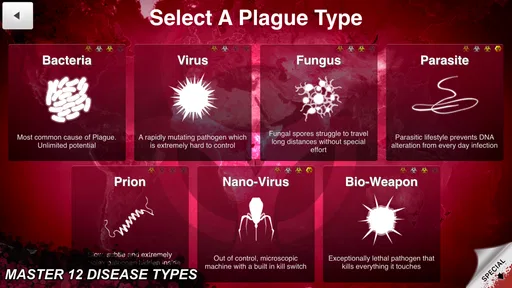
First things first, Plague Inc. is not your typical strategy game. You start by choosing your disease type—bacteria, virus, fungus, and so on. Each type comes with its own quirks and challenges, keeping the gameplay fresh and interesting. Once you’ve picked your poison, you get to name your new world-ending disease. I went with "Doom Bug," because why not?
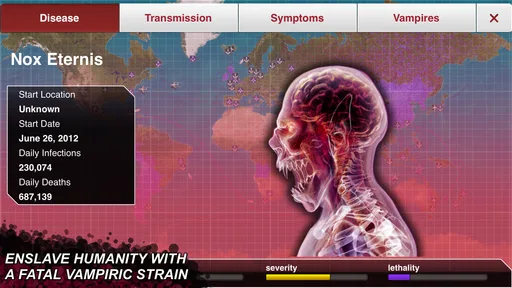
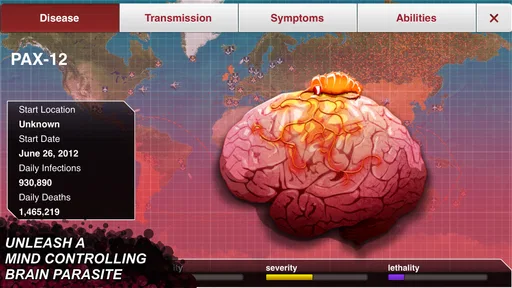
The game kicks off with you selecting a country to unleash your pathogen. This decision is crucial, as it affects how quickly your disease can spread. Once you’ve made your choice, it’s all about evolving your disease to outsmart humanity’s efforts to stop you. You’ll be tweaking its transmission, symptoms, and abilities to maximize its lethality.
The Strategy Behind the Sickness
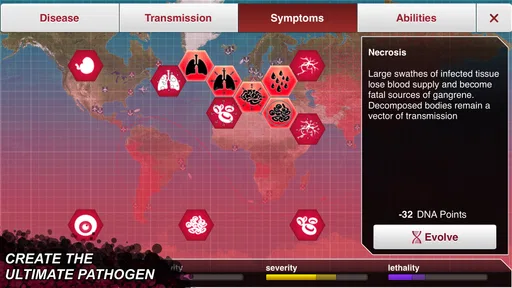
The real beauty of Plague Inc. lies in its strategic depth. As you progress, you’ll earn DNA points, which are used to evolve your disease. Do you want to make it airborne to spread faster, or perhaps add some nasty symptoms to increase its lethality? The choices are yours, and every decision counts. It’s like playing chess but with germs!
The game’s AI is no slouch either. Countries will start closing borders, developing a cure, and taking measures to slow down the spread of your disease. It’s a race against time, and the tension can be palpable, especially when a cure is nearing completion. That’s when you start biting your nails, hoping your little pathogen can outwit the world’s best scientists.
Aesthetics and Experience
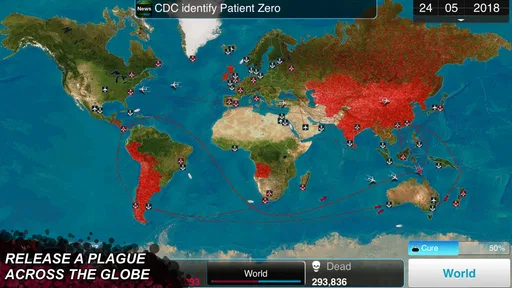
Visually, the game is clean and straightforward. The world map is your playground, showing the spread of your disease with red dots that slowly cover the globe. It’s oddly satisfying watching those dots multiply, knowing you’re one step closer to winning. The interface is intuitive, making it easy to navigate through the different menus and options.
The sound design is subtle but effective. You’ll hear the ominous background music that fits perfectly with the game’s theme, along with satisfying sound effects every time you evolve your disease or a country succumbs to your pathogen. It all adds up to create an immersive experience that keeps you glued to your screen.
Replayability and Challenges
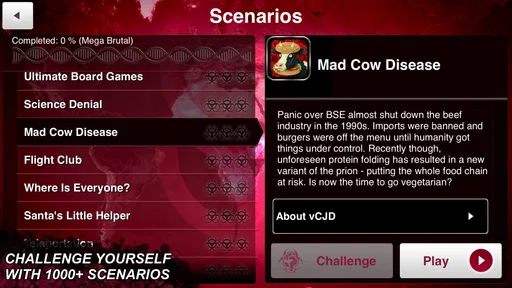
If you think you can beat the game in one go, think again. Plague Inc. is all about replayability. Each playthrough is different, thanks to the variety of disease types and the procedural nature of the game. Plus, there are different difficulty levels and scenarios to keep things challenging.
You can also try your hand at the game’s numerous achievements, which add an extra layer of fun. Ever wanted to infect the world with a mind-controlling fungus? There’s an achievement for that. It’s these little challenges that keep you coming back for more.
Practical details before you start
As a mobile simulation game from Ndemic Creations, it suits quick sessions as well as longer attempts when I want to follow a run through its changing stages. It is free to start, with in-app purchases ranging from $0.99 to $14.99 per item. I would approach those purchases as optional extras rather than a reason to rush: the core appeal is learning how to make better decisions, not collecting upgrades without a plan.
The game was released on October 4, 2012, and its current version is 1.24.4, with Android 6.0 as the minimum operating system requirement. Its average rating is 4.7 from around 4 million ratings, and it has passed 100 million installs. Those figures suggest a long-running audience, but the more useful question for me is whether its deliberate, pressure-based loop matches the kind of play you want.
A useful way to approach a session
For an everyday example, imagine opening the game while waiting for an appointment. I would start a run, make the initial choices, then pause long enough to read the map before spending each new batch of DNA points. If I only have a few minutes, that is a satisfying slice of play; if the response becomes urgent, I can decide whether I want to stay with the run or save a more focused attempt for later. It is not a game I would leave unattended and expect to manage itself.
A practical tip is to think in stages rather than trying to make the pathogen powerful in every way at once. First ask whether it is spreading where you need it to; then watch how the world responds; only after that decide whether your next investment should address reach or danger. This does not guarantee a win, but it keeps each purchase tied to an observable problem. It also makes a failed run easier to learn from, because you can trace the outcome back to a choice instead of blaming luck alone.
What repetition feels like in practice
Different disease types and challenges give the game reasons to revisit its central decisions, yet the map, evolution choices, and race against the cure remain the heart of the experience. That consistency is a benefit if you like improving through repeated attempts. It is a limitation if you need a game to keep changing its basic activity. I would not buy into the idea that every run will feel wholly new; the interest comes more from testing a different approach against a familiar strategic problem.
There is also a useful distinction between learning the interface and learning the strategy. The menus are approachable, so a new player can begin making choices without first mastering complicated controls. But understanding when a choice is well-timed takes longer. If early attempts go badly, I would change one part of the plan at a time rather than trying to alter everything at once. That makes cause and effect clearer and turns experimentation into a more rewarding part of play.
A focused simulation with a dark edge
The subject matter is the first thing I would mention to someone considering it. The game treats a worldwide outbreak as an abstract strategic challenge, not as a lighthearted setting, and that tone will not work for everyone. The age rating is Everyone 10+, but that does not replace a parent’s judgement about whether the theme is appropriate for a particular child. I would also skip it if disease-centered fiction is uncomfortable, regardless of how much I enjoy its decision-making.
For players who are comfortable with the premise, the abstraction is part of the design’s appeal: a map, evolving traits, and a response that forces you to reconsider priorities. It does not offer the tactile building and upkeep of a management sim, nor the character-driven progression of a story game. I see it as a compact systems puzzle with a bleak theme, best enjoyed by someone who likes to study outcomes and refine a plan rather than simply watch events unfold.
Final Thoughts
In a world full of strategy games, Plague Inc. stands out with its unique premise and engaging gameplay. It’s a game that makes you think and strategize, all while giving you the slightly guilty pleasure of orchestrating a global pandemic. Whether you’re a fan of strategy games or just looking for something different, Plague Inc. is definitely worth checking out.
So, are you ready to take on the world and see if you can outsmart the human race? Download Plague Inc. today and start plotting your path to world domination. Just remember, it’s only a game... or is it?
Verdict
Strengths of Plague Inc.
- Innovative gameplay simulating disease spread.
- Educational insights into global health.
- User-friendly interface with intuitive controls.
- Challenging scenarios increase replayability.
- Regular updates with new features and content.
Limitations of Plague Inc.
- Can be difficult for beginners to master.
- Requires strategic thinking; not for casual play.
- In-app purchases can be costly.
- Some scenarios feel repetitive over time.
- Limited offline functionality; needs internet.
Other Releases by Ndemic Creations
View All
Plague Inc: Scenario Creator
Productivity4.3

Rebel Inc: Scenario Creator
Entertainment4.2
Similar Picks in This Category
View All
Truckers of Europe 3
Wanda Software4.3

Town Building Life Simulator
XGame Global4.2

Fidget Toys Trading・Pop It 3D
Freeplay Inc4.7

Sculpt People
CrazyLabs LTD4.4

Scary Teacher 3D
Z & K Games4.2

Hair Tattoo: Barber Shop Game
CASUAL AZUR GAMES4.3
Frequently Asked Questions
What is the objective of Plague Inc.?
Plague Inc. is a strategy simulation game where your goal is to create and evolve a pathogen to infect and ultimately wipe out the human population. Players must strategically manage their pathogen's spread, mutation, and resistance against global efforts to find a cure. It combines realistic simulation with strategic planning.
Is Plague Inc. suitable for all ages?
Plague Inc. is rated for players aged 12 and up due to its themes of global infection and pandemic simulation. Its strategic gameplay and realistic scenarios may not be suitable for younger children. Parents should review the game's content to ensure it aligns with their comfort levels regarding strategic and potentially mature themes.
Does Plague Inc. require an internet connection to play?
Plague Inc. can be played offline, which means you can enjoy its strategic gameplay without an internet connection. However, some features like updates, downloading new content, or accessing leaderboards may require connectivity. Playing offline also makes it a great option for on-the-go gaming without worrying about data usage.
Are there in-app purchases in Plague Inc.?
Yes, Plague Inc. includes optional in-app purchases. Players can buy expansions, additional scenarios, or fast-track certain elements of the game. These purchases enhance the gameplay experience but are not necessary to enjoy the core game. Players can choose to engage with these options based on their preferences.
How does Plague Inc. simulate pandemic scenarios?
Plague Inc. uses a complex algorithm to simulate the spread of diseases globally. It takes into account real-world factors such as climate, population density, and international travel. This realistic approach provides players with a strategic challenge as they adapt their pathogen to overcome various obstacles while striving to infect the entire world.
Play our best games!


